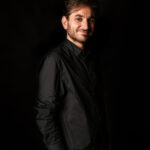
Maurizio Grandinetti is an Italian guitarist internationally recognized for his work as a soloist and chamber musician. He has collaborated with leading ensembles and has over twenty-five years of experience as a teacher. Currently based in Basel, he has personally witnessed the evolution that has shaped avant-garde music into what it is today.We discussed these topics together in a conversation that allowed us not only to examine the role the guitar currently plays within this context, but also to reflect on the challenges and critical issues that the avant-garde scene is facing today.


Maurizio, thank you very much for accepting our invitation.
For several years now, you have been alternating between the classical/early repertoire and contemporary music. How important do you think it is to engage with such different genres in order to approach music of new creation?
Salvatore Sciarrino, in a book that had a great impact on me, writes:
“One must connect the facts of modern thought with one another and with the facts of tradition. I am convinced that the evolution of music consists in the transgressions of individual figures with respect to a commonly accepted vocabulary. Transgression allows us to distinguish, to a greater or lesser extent, the physiognomy of an author from that of his fathers (or his brothers). In other words, the more transgressive the language, the more personal it becomes.”
If we accept this definition, we must agree that no one exists disconnected from the reality and the history that have shaped them. An interpreter today is someone who has absorbed the stratification of multiple traditions and musical genres, sometimes even unconsciously. I believe that if one does not understand the transgressions of a Monteverdi (or Beethoven, Schubert, Schoenberg, Miles Davis, John Coltrane, or Jimi Hendrix) in relation to their own time, it will be difficult to develop the sensitivity needed to decipher contemporary codes.
Your career includes numerous collaborations, which we will explore step by step throughout this conversation. Where does your interest in contemporary music come from?
It developed in a very natural way. During the years of my training, contemporary music was a well-integrated genre within the political, social, and musical environment. As a teenager, I was an avid reader of rock culture magazines such as Ciao 2001 and Muzak, where—alongside the exploits of youthful rock icons—one could also encounter the experiments of John Cage and Karlheinz Stockhausen. It was not easy for me to find recordings of this music, but I shared its ideological foundations.
Over the years, figures such as Maurizio Pollini—and even more so the Dutch school of Baroque performers (Frans Brüggen and Kees Boeke come to mind), who presented themselves almost like a band and performed Machaut and Cage side by side—had a strong influence on many musicians. In his own way, even a figure of great stature such as Claudio Scimone (director of I Solisti Veneti and a key figure in the rediscovery of Venetian Baroque music) approached Vivaldi and Donatoni with the same passion. At times, as an encore after performing The Four Seasons, he would present contemporary works, saying: “This music needs to be listened to a second time in order to be better understood!”
There was great courage in such examples. Ultimately, all the people who inspired my studies made no distinction between styles: my guitar teachers regularly performed the music of their own time. In Rome, Bruno Battisti d’Amario played solo and chamber works by Petrassi and Morricone, while Oscar Ghiglia performed pieces by Donatoni and Bracali. Italian publishing houses were also very active in releasing new music, making it readily accessible.
The transition from the classical guitar to the electric guitar has been a crucial process in the development of new repertoire, especially over the past decades. Did you experience it as a challenge or as a necessary turning point? Did you encounter any difficulties?
In the final years of the twentieth century, it suddenly seemed very natural for a new generation of composers to use electric guitars, keyboards, and amplifiers. During those years, I encountered, among others, Rebecca Saunders and Olga Neuwirth, whose works I performed at the time: Photophorus for two electric guitars and orchestra, Hommage à Klaus Nomi, and Lost Highway. Tools such as the E-bow, bottleneck, and wah-wah pedal were combined in the score with sampled sounds, and for me this represented a moment of growth that was not always easy. One had to understand a kind of sound world that could perhaps be found hidden between the notes of progressive guitarists, yet over which I still had limited technical control.
Minimalist composition also turned quite naturally toward the electric guitar, though it tended to use it in a less complex way in terms of the required sound palette: it rarely went beyond the clean/distorted dichotomy (Louis Andriessen’s Hout, or many New York–based works from the repertoire of the Bang on a Can ensemble, by composers such as Lois Vierk and Julia Wolfe, among others).
In the early years of the instrument’s history, it was quite common to be told, “it has to sound like…”—followed by a reference to a legendary guitarist. Over time, however, the electric guitar has become a protean tool: each composer experimented with entirely personal effects and techniques, to the point that the guitarist’s traditional know-how often remained largely unused. One had, so to speak, to relearn the instrument from scratch each time—something that was far from free of difficulties.
Since 2000, you have been a member of Ensemble Phoenix. How did this collaboration come about?
During my years of study at the Musik-Akademie in Basel, I had the opportunity to perform with the Ensemble IGNM Basel, at the time curated and directed by Jürg Wyttenbach. Jürg (who over the years became both a constant point of reference and a friend) involved me in several concerts. Among the ensemble’s last performances, there was a (for me, legendary) rendition of Frederic Rzewski’s Coming Together, organized by the pianist Jürg Henneberger. I won’t call him young, because in that group we all were: among others, the saxophonist Marcus Weiss, the flautist Philippe Racine, and the clarinetist Ernesto Molinari.
From 1993 to 2000, I did not live in Switzerland and had lost contact with that world. However, upon my return to Basel (following my wife Consuelo), I reconnected with Jürg Henneberger, who immediately involved me in Ensemble Phoenix. Since then, our collaboration has been continuous, and I have performed many premieres and chamber works with the guitar alongside the ensemble.
For those curious, a (partial) archive of Ensemble Phoenix’s performances can be found here.
You studied and lived in Basel, a city rich in artists and a cradle of new musical currents that have influenced contemporary cultural life. How much has this environment shaped your path, and how have you seen the city transform over the years?
Being the guitarist of Ensemble Phoenix naturally facilitated my exploration of Basel’s musical environment. Basel is, first and foremost, the city of galleries and museums that regularly showcase the most important and innovative artists. One is constantly stimulated by cultural and artistic events, including—but not limited to—music.
Regarding music more specifically, my gratitude goes to the two Jürgs mentioned earlier: Wyttenbach and Henneberger. Jürg Wyttenbach embodied an extremely open European culture, combining Scelsi and Stockhausen, yet at the same time he was a rigorously traditional musician (his critical performances of Beethoven’s sonatas are legendary). Over the years, I performed almost all the solo works I learned for him and received lessons that were absolutely formative. Jürg Henneberger taught me how to play in an ensemble and introduced me to that circle of friends that became Ensemble Phoenix.
One of the ensemble’s defining characteristics was its attention to artists outside the academy. Basel had, for years, an improvisation/noise/avant-garde scene, and I came into contact with Alex Buess, who also wrote a lengthy composition for electric guitar (included on my CD/vinyl Seek). Over the years, I collaborated with many other artists, including Volker Heyn, Phill Niblock, John Duncan, Dror Feiler, and Zbigniew Karkowski. Around the study of electronic music, Thomas Kessler (whose works I performed) had created another hub of stimulating musicians with whom I had the chance to collaborate. Experiences with the city’s orchestras (Sinfonie Orchester, Sinfonietta, and Kammerorchester Basel) as well as numerous theater productions were also very important.
Having had such an extensive career as a performer, what do you think have been the parameters that have changed in contemporary music over the last twenty years?
I fear that contemporary music is increasingly closing in on itself within a specialized, academic environment. Over the years, I have experienced what I consider two failures of the contemporary movement. The first is social isolation and the creation of a ghetto. In my city, Basel, until the early 2000s, contemporary music was hosted in many different venues across the city. Since the creation of a single, dedicated space for new music and for specialists in the field, in my view, isolation from the rest of the city has begun. I remain attached to the idea that music thrives on encounters between human beings, and that it should be a primary objective of any musician to connect with the society around them, in all its definitions and contradictions. Isolation is deadly.
The second issue is that contemporary music has not become a universal language, open to expressions from all continents. There exists a sort of center of gravity in the German–Central European area, and a periphery that increasingly struggles to maintain its own distinctiveness. To make myself clear, I take jazz as an example: today, jazz encompasses a multitude of musics with different identities (Scandinavian, Middle Eastern, African, urban, and others) and has somehow survived beyond merely replicating itself. In my opinion, contemporary music is increasingly becoming an expression coming mainly from Central European academies. Compared to past decades, these trends seem to me regressions.
Let’s move to one of the collaborations that interested you the most: that with Ensemble Phoenix and Pablo Marquez in the double guitar concerto Fenix by Javier Torres Maldonado. How did this collaboration come about? What was the interaction like during the composition of the piece?
After a concert by Pablo, in which he had performed a piece by Javier with electronics, the idea for the collaboration arose over the usual post-concert beer, and Ensemble Phoenix (with the attention they always gave to my proposals) agreed. Unfortunately, the concert was scheduled right when the Covid lockdown began, so it was canceled. The ensemble made a special effort to record the program (also as a way to provide financial support to freelance musicians), and SRF2 agreed to collaborate. The concert eventually became a vinyl production, which is available on Bandcamp.
Working with Pablo Marquez set a very high professional and musical standard for me: his attention to sound production, timbre, and meticulous detail perception is absolute. The period spent studying the piece had something “romantic” about it in its own way that I will never forget: the particularly snowy winter, the streets completely silent due to the absence of traffic (even air traffic), and the continuous correspondence with Javier, who was in Milan and unable to attend rehearsals. It felt as if we had gone back 50 years. Javier’s absence was indeed challenging, because the timbral and technical realization of the microtonal sounds, which he envisioned with absolute precision, was not easy to convey via Zoom.
In addition to being a recognized performer, you also have many years of experience as a teacher. How do these two areas influence each other? Do you follow a specific method?
I taught for 24 years at Italian conservatories, spent several years at the Musikhochschule in Karlsruhe, and for many years led guitar courses in Montepulciano at the Europäische Akademie of the Musikhochschule in Cologne. I ended this chapter two years ago (resigning from both the conservatory and Montepulciano), partly for family reasons but also due to my own difficulty in fully believing in my work as a teacher. For the past two years, I have been dedicating myself passionately to my work at the Musikschule in Liestal, where I hope to leave a significant mark on the education of very young guitarists.
Would you like to tell us about some of your upcoming projects?
I have many projects with the Guitar-Arp Duo with my wife Consuelo (a harpist). I find it fascinating that the guitar-harp duo, which offers enormous possibilities, has never really captured the attention of composers. It is incredible, for example, that there is not a single 19th-century composition for this formation, and in the 20th century they can be counted on one hand. We are working on a series of transcriptions (including for historical instruments) to create an “imaginary repertoire” that could serve as inspiration for today’s composers to write for this duo.
For the past ten years, with my friends in the quartet AperOHR (flute, clarinet, harp, and guitar), I have been organizing four concerts a year at the Kulturscheune in Liestal (a beautiful jazz club and concert hall). The new season is about to begin, in which we will, for example, collaborate with a soloist on the Senegalese kora. Additionally, there are many solo guitar compositions on my music stand waiting to be performed and recorded.
About The Author