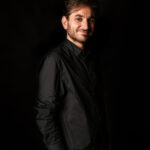
Analyzing the relationship between Maurizio Pisati and the guitar might even seem superfluous nowadays. Much has been said about his studies, his transcriptions, and his chamber works that highlight the six strings. Yet beyond the music, the world that the Milanese composer has managed to create is the result of numerous artistic references. The true key to our conversation was this: to use the writers, filmmakers, and poets who have most influenced Maurizio Pisati’s compositional choices as an analytical lens—tracing the indelible imprint of his music.


Maurizio, first of all, thank you for giving us your time. I’d like to begin by asking you a question about an author who is clearly a reference point for you: Marina Tsvetaeva.
Reading some of her writings, it’s immediately apparent that there is a connection to your aesthetics and ideas. As a first observation, I noticed that you both share the use of the word “lightness.” I’m thinking of the poem “Think of me lightly, forget me lightly,” or the beginning of “Infinitely happy.” Reading these lines, I thought of your way of composing and was reminded of the performance instructions you include in your pieces. “Light, always” from Study No. 3 and “Very light and sparkling” from No. 4 are just a couple of examples. Do you think your music seeks to evoke the same sensations that Tsvetaeva conveys through this word?
“Think of me lightly, forget me lightly.”
Rewriting these words is pleasant and sweet—they’re the first ones you mentioned and also the first ones by Marina that I used in a composition.
This lightness, and the kind I write as a “technical” instruction in my scores, are two different types, but they share a common trait—one I’ve never wanted to explain explicitly in the score. And it’s precisely the kind of lightness Marina Tsvetaeva speaks of. That is to say: to express it fully, I would have to explain it, to describe how that lightness translates into many different technical approaches in music—but it would take too long, and still wouldn’t be enough. I say this because I have, in fact, tried to do it—and eventually decided to scatter my pieces with words that could lead the Performer back to those concepts. So you’ll find instructions like “light, always”, or “elusive”, but also “immediately”, which is also part of another idea, but still points to not lingering. Or “barely suggested,” “just touching,” “to oneself,” “like singing to oneself”, and once I even wrote “like humming at home”, which is like a mother humming while cleaning the floor, remembering some lyrics and replacing the forgotten ones with “nai na naaai…”
That kind of lightness, precisely: a song just hinted at, sung inwardly, while doing something else—which seems to be the main task, but which still gives rise to singing. All this, as you suspected, turns into a kind of lightness of thought that aims toward introspection—or rather, concentration. The musician sometimes seems distracted, but is simply focused. I often find myself in a near-constant state of ready for invention—so, if that happens while I’m writing, I use it. But if it happens through the input of someone else, often a student, the idea passes to them. Many times I say things in class that I wish I had thought of for myself—but by then, the idea has taken root in someone else’s music. And watching the engine start, seeing the class running at full speed, is deeply satisfying…
Staying with Marina Cvetaeva, the phrase “I am a page for your pen. I receive everything. I am a blank page” made me think a lot about Theater of dawn and the hand gesture of writing that accompanies the ensemble during the performance.
“My book must be performed like a Sonata. The signs are the notes. It is up to the reader to realize or deform,” seems to summarize your music. If we think about your works for guitar, the sound obtained undergoes a fundamental transformation, assuming another state, almost as if wanting to deform its normal execution.
Yes, if the lightness mentioned before was still conscious and sought— but somehow “artificial,” that is, thought out, achieved, constructed — this instead is for me one of the most “ancient” objectives. It is part of that “focused” attitude I mentioned earlier, but it lives from the awareness of a blank page always open.
It also comes from Rilke (the Rilke-Cvetaeva correspondence is incredible, he fell in love “by letter,” and who wouldn’t have), when he says that if we were not thrown forcibly into the world of words, we would never learn to speak.
The sign: any sign is a summary of a world, even just writing on a blank page “I don’t know how to start.” That is already the beginning, then it can be erased, and those would already be two acts of invention, but if you erase, you are already heading toward another one, and so on, until you find yourself immersed in the new composition.
Rilke said precisely, before the sentence I just quoted, “I don’t know how to begin.” I have always thought that if he said such a thing, he who started and finished so many great and important things, every little attempt of ours to begin is already something concrete.
There is also Marina Cvetaeva’s Poem of the Table (Poema del Tavolo, in italian), from memory, maybe it is simply titled Tavolo. At one point, it reveals the thing that most brings me close: it says that the table, in the end, remained a living trunk, with resin and leaves, and — otherwise it wouldn’t be Marina Cvetaeva — even with roots still planted in the earth.
From this Tavolo and the things we mentioned earlier, UMBRA was born (a chamber music theater work, Ensemble with Guitar, voice, dancer…), Tentativo di Stanza for solo voice, and finally, without voice or text anymore: Poema della Luce, for solo Guitar.
Having mentioned Rilke in the previous response, I feel it’s essential to cite some of his works. In his Notebooks of Malte Laurids Brigge, I believe there is an “ideal” sentence—a perfect fil rouge that connects your way of perceiving ideas and sensations to the final sonic result that eventually reaches the listener.
“One should wait and gather sense and sweetness for a whole lifetime, a long one if possible—and then, at the very end, one might perhaps be able to write ten good lines. For verses are not, as people imagine, simply feelings (one has them early enough)—they are experiences. […] And even having memories is not enough. One must be able to forget them, if they are many, and have the great patience to let them return.”
I have a vivid memory of these lines by Rilke: the first time I read them, they felt like a warning, a kind of admonition, accompanied by the feeling that I couldn’t fully understand them—because the words were imbued with an experience I hadn’t yet lived. Now that you bring them before me again, after so much time, I realize that it has indeed gone just that way, at least up until now: in those years I used to write very quickly, and Giacomo Manzoni—whom I was studying with at the time, after the courses with Sciarrino—often advised me to slow down (and he probably meant to suggest that I “reflect” as well).
Now my thoughts are even faster and more branching, but the process of invention has taken on a different pace: sometimes I deliberately suspend and delay, I make two or more versions—of certain passages or even just of the signs I use—and these steps always lead me, inevitably, to erasure, to “not saying,” to saying only what matters.
Because, precisely, music is not feelings, but an experience—and composing is an experience recorded live. So it is a beautiful thing to prolong it and to recognize, in what I’m doing, the gestures of discovery and those of mannerism, trying to eliminate the latter and, with a bit of luck, to invent.
The fear of mannerism, to be honest, has accompanied me almost from the beginning. At times I’ve even stated it in the presentation of a piece, especially in recent years. Yes, because having taken, in some of my works, the path of “translation” rather than “transcription,” the fear of mannerism has been joined by the fear of my own mannerism—and the anxiety that I might be seeking, in translation, a safe refuge. It might be a limitation, and perhaps that’s why I’ve never done a true “transcription,” but finishing a piece with the intimate conviction of having been sincere is something that comforts me and helps me overcome even the idea of having truly “finished” it.
At that point begins the work of/with someone else—the performers—and it almost feels like I can start all over again. Yes, it’s a kind of loop. If a computer programmer were to read these last lines, they would likely see a recursive function in them, a system that calls itself in an almost circular way, and that, if desired, can become a loop.
“Here, time is not measured, no deadline matters, and ten years are nothing. To be an artist means: not to calculate or count.”
“And everything fell silent. Yet in that silence, a new beginning advanced—gesture and transformation.”
Perhaps many have already asked you this, and I hope I’m not being repetitive. The question of timing—it’s a subject often discussed. Silence has long been studied by artists and scholars. However, Rilke is not merely referring to a single moment, to an isolated act, but rather to a point of departure through which the subject follows a natural law of things. I almost feel like saying that, in this case, silence itself becomes part of the chaos, of the frenzy that binds various ideas together. It’s almost a real sound in itself.
How important are silence and time in your works?
We both know how much rhetoric surrounds this discourse on silence—especially when referring to something like music, which could not exist without silence around it, but which, by its very nature, breaks silence. Or, at the very least, it interprets it.
Still, your question is appropriate, and I always carry two thoughts about silence with me.
The first concerns the technical silence of the musician—the rest, the temporary suspension of sound—which, regardless of any intention or will on my part, has taken on a special meaning for me. There was a moment in my life when I experienced deep pain from the loss of a close family member. It struck me in a way nothing ever had before, and the naive, youthful belief in being somehow invulnerable suddenly crumbled. It introduced me to the world of absence.
What followed was a period in which, in every piece I wrote (R1, R2, R3, and many others), I notated two metronomes: one fast and discursive, the other dedicated solely to the pauses—a metronome moving at an almost exasperating slowness. It was the desire to inhabit a time that, I would say, always flows beneath the one that propels us forward—a time ready to reveal itself at any moment and to take parts of us away, or even all of us entirely.
The second idea is purely poetic: I believe every piece should begin, flow, and end in a way that earns the silence that follows its conclusion. This idea of “earning” may, on reflection, seem a bit moralistic—I’m not sure, maybe it is—but in any case, to me every ending is exactly that: the coherence of a formal and poetic unfolding that rightfully leads to silence.
Not the silence of real life—because in real life, at the end of the piece, there is applause. I mean the silence that comes a fraction of a second after the pen has drawn the double bar lines. In the composer’s mind, that moment holds a particular silence—a true silence. I’ve often considered not writing those final double bars. I actually did so once. But I later realized that, for me, it would’ve been a purely graphic gesture, because in fact, my double bars were more silent than their absence. They told me something about what comes next.
If I think about how I ended pieces like Theatre of Dawn—the elaborated sound of my pen writing, interacting with the performers, the only light on stage being the projection of the paper with the hand and pen in motion—or STOCK, where the 12-meter painting and the Japanese poem that shaped the piece appeared hanging from the ceiling, perpendicular to a drum resting on the floor, with the percussionist playing the skin and the ground—if I think of just these two endings, I can say that the intention was clear: I was trying to earn the ending, and the silence that would follow.
Even now, I compose my final thoughts in the same way. Paradoxically, applause breaks something important—but more often than not, I’m the first to start it myself, directing it toward the performers. And so I remain quietly convinced that that silence still lingers in each of the listeners, even as we all celebrate the skill of those who performed.
Let’s set literature aside for a moment and move into the realm of cinema. Stalker is a 1979 film by Tarkovsky, clearly inspired by the Strugatsky brothers’ novel Roadside Picnic. The two protagonists, accompanied by a guide—called the “stalker” in the film—venture into the mysterious “Zone,” a territory where it is said one’s deepest and most hidden desires may come true. The journey becomes an inner exploration, leading the characters to confront their fears and examine their desires and feelings.
“Zone” is also the name of one of your personal projects—closely connected to the concept of “flexibility,” which, according to Tarkovsky himself, represents “the freshness of existence.”
What exactly is Zone?
The ZONE project was born directly from the powerful impact that film had on me. I was barely more than a teenager when I left the cinema with the vision of an inner journey—but more than anything, with the idea that the “Zone” was a place (a mental space?) from which there was no return. No path inside the Zone could be walked back. When you turned around, the road had changed. The room was no longer the same. Now it was raining in that room. Now there was only emptiness. Now it was an open space where water flowed.
By now, my memory of Stalker has probably changed too—but I’ve never wanted to watch it again. It’s very likely those memories are distorted, or even manipulated and reshaped by my own work.
One thing is certain, though: the experience of that film altered something in my perception. The very next day, I began composing a piece for piano that was a direct emanation of that impression. It was titled Alle stanze, vuote (“To the rooms, empty”).
Then ZONE evolved into a performance project, a group of musicians whom I would “call upon,” from time to time, to perform my new works. At times, it turned into a guided improvisation group, but most often it was an ensemble that—like one of those zones—never appeared the same way twice.
With ZONE, for example, I worked in a duo with my Kali teacher (Filipino martial arts), Maurizio Maltese. He would perform his combat—using sticks and bare hands—directly on the strings of my electric guitar: his hands in duo with mine. The guitar was part of a MIDI system that divided the fretboard into multiple zones, each assigned with samples or musical phrases from past ZONE performers.
Over time, the ZONE performers included the flutes of Manuel Zurria, Antonio Politano, Birgit Nolte; the percussion of Maurizio Ben Omar; the cello of Mario Brunello; the voices of a poet and a philosopher—Roberto Sanesi and Carlo Sini; the Panormo guitar of Elena Càsoli; the algorithms of Davide Rocchesso and Alvise Vidolin; the voices of actress and dancer Elena Callegari, of Ursula Joss and Marco Bortoli; the tango of Alejandro Angelica and Alessandra Rizzotti—and even Walter Goy and his photocopier, properly miked and processed live.
These instruments, in every concert, would also inhabit a region of my guitar’s fretboard: I played their sounds using guitar techniques—modifying, for example, a flute or piano sound through guitar-style bending, and so on.
I had my ensemble beneath my fingertips, and all of them in front of me on stage, in direct dialogue.
It seems that ZONE has produced some “side effects”: collaborations, publications, new music…
Some of those compositions have entered my Ricordi catalog, and since 2016 they have also given rise to a concert series: pactaSOUNDzone.
The ZONE logo became part of another logo—combined with the name of the theatre company that hosts the project: PACTA—to make room for the fundamental word: sound.
In short, pactaSOUNDzone is a project that runs parallel to my compositional zones: it’s not a traditional concert series but rather a sequence of visual and sonic situations, in which I invite musicians whose poetic vision includes a strong need for visual and lighting design.
Theatre, with its perpetual fiction, allows us to create almost total sensory experiences. In this endeavor, I act as a bridge between the invited young artists and the audience—in other words, I serve as the artistic director of the series, ensuring that its direction remains faithful to its original intent, which hasn’t changed since that long-ago night at the cinema.
Every zone is without return.
I often find myself in a room like one of those in Stalker: a large, empty space (the theatre is PACTA Salone, a historic venue in Milan—formerly the CRT, Center for Theatre Research) where we can, if we want, through theatrical artifice, make it rain or travel to the moon.
Last year, the series was titled—recalling a phrase by Leonardo da Vinci—“How is the moon?”


What role has the guitar played—and does it still play—within this sonic laboratory?
In all of this, the guitar has played a guiding role. Not necessarily a central one, but certainly a constant and ever-evolving presence.
For me, the guitar is the emotional and tactile experience through which many sonic perceptions are filtered. I love translating onto the guitar—whether through improvisation or not—any sound or acoustic phenomenon I hear. It’s a game I’ve always played, and one from which I draw real creative energy.
Maintaining constant contact with the instrument is, for me, an essential part of the compositional process. It’s a relationship of continuous exchange, where one nourishes the other and vice versa: my compositional thinking has been enriched by instrumental practice, just as my practice has often shifted and discovered new directions thanks to compositional thought.
I began composing the Sette Studi in the early 1980s, and since then “my” guitar has gradually reappropriated its so-called traditional sound. I’ve used this instrument in the most varied ensembles—because there is no instrument the guitar cannot engage in dialogue with. It’s simply a matter of knowing the material: both the compositional material and the physical matter of which the guitar is made—its weight, range, tensions—while understanding that in the air which carries music, there are countless spaces in which the guitar can be clearly heard, often with the most prominent voice.
Finally, ZONE and the guitar have also become part of my work in translation—which I always distinguish from transcription, something I’ve never truly practiced.
I have transcribed, by translating, works by Scarlatti, Sciarrino, Maderna, Dowland, Byrd, and Vivaldi, in the most varied instrumental formations—but always with a spirit of invention and personal exploration. My intention was never to correctly transpose their notes for a new instrument. Rather, I sought in their thoughts the ones that could welcome mine, and together generate music not yet imagined.
I can say that I composed my translations, whereas I could never compose a transcription.
Of course, this is only possible when one recognizes and gives full value to the original text—honoring the debt we owe to it—and sometimes, without realizing it, in translating a piece of music we may end up revealing one of its true transcriptions.
Your translations also seem to arise from a “special” connection between your music and the works of Roberto Sanesi, whom you’ve already mentioned.
Yes, Roberto Sanesi the translator is a fundamental reference point for Italian scholars of Anglo-American literature—and he was a Poet.
I first encountered him in that very form: his visual poetry and his more literary writings reached me thanks to my involvement in theatre. He immediately became a Maestro to me.
The teachers who contributed to my formation include Sciarrino, Manzoni, Guarnieri—and then there are those I discovered and chose later, because my path eventually led me to them: among them Leoninus and Perotinus, with their pure, incomparable lines and counterpoints—and, of course, Roberto Sanesi.
He guided me, gently navigating my literary and formal gaps, helping me shape the spoken and sung word, the recited word, and eventually even the thought word.
It was at that point—when even the thought word received the impulse that Roberto could transmit with nothing more than a simple greeting—that our pens finally crossed paths.
From that meeting came TAXI!, a chamber opera. And even before that, Quanti animali parlanti (“How Many Speaking Animals”), both works using his words and even his voice.
I’d like to dwell a little longer on the theme of writing, and explore its purely aesthetic dimension within your musical language. What is your relationship with signs? In your guitar works, they seem to take on an almost pictorial direction.
Let me answer by continuing and completing the line of thought:
After those two pieces, I began to understand Sanesi’s visual poetry as well—the pictorial work he created with the “leftovers” of translation.
Words that translation had to discard, or enhance beyond the original, became for him the very material of signs and pictorial gestures. He would channel both his poetic vision and literary knowledge into a single visual surface.
From that lesson, I learned to no longer fear the graphic aspect of the musical sign—to no longer worry that it might be dismissed as mere decorative “graphicism.” Instead, I began to invest my notational signs with all the essential meaning that musical interpretation demands. At times, I even entrusted the sign itself with an additional potential—a way for the performer to find a personal path through the piece.
From that same lesson, I also came to understand the value of translation—of saying beyond—with full awareness that the translated text could, without being distorted, filter into my own thinking and give rise to new inventions.
Over time, beyond its graphic dimension, your music for guitar has undergone a significant aesthetic metamorphosis. Theatre of Dawn and Poema della Luce seem to follow parallel paths that nonetheless give rise to very distinct materials.
These paths—interconnected and intertwined—have continued to evolve up to the present day. But around the year 2000, I felt the need, specifically and exclusively for the guitar, to create a piece of a different nature, or rather, of a different inspiration.
No longer short pieces like the Studies (each certainly connected in a single musical thought, but still seven distinct works), nor the Duets (seven duets born from the Studies and written for the theatre work Theatre of Dawn, where the guitar pairs with, in turn, Voice, Saxophone, Bass Clarinet, Percussion, Recorder, Viola, and Double Bass).
No, this time I wanted a single, “long” piece—nearly 14 minutes—in which the timbral and technical environment would stand in contrast to all my previous pieces for this instrument: Poema della Luce, for solo Guitar or Guitar with Audio Track.
In the earlier pieces, the guitar’s ordinary sound would appear only in flashes, and the goal was to reveal its hidden “specialness.”
In Poema, by contrast, the guitar presents itself from the start in its traditional voice, while the techniques I had developed in the Studies become the new “special” elements. But most importantly, surrounding the guitar in Poema della Luce is an Audio Track containing experiences, instruments, voices, fragments, and resonances from nearly all the previous ZONEs.
It’s a piece with an “unspeakable” form—and perhaps one of the few of mine with a true dedication. There is no such form as “Elenìa”; rather, this is a “grand Elenìa for the concert hall.” Elena Càsoli had premiered the Studies, both individually and as a full cycle—but those works had originated before I met her. In this case, however, the piece was conceived entirely for her: a performer capable of sustaining an emotional weight and a level of technical and interpretive tension that goes far beyond the norm.
For some reason—perhaps an intuitively graspable one, though not deliberate—this piece was, after a long time, the first to omit the word “zone” from the title. Here, the zones were the piece itself. Finally—and through the guitar—I had recreated my own Stalker: in Poema della Luce, the live guitar wanders through the sounds of the Audio Track, never returning, trying to look back, but in vain—forced to press forward to the end.
And instead of a fade to black, as one might expect, I asked—during the premiere in Australia—that the lights be gradually increased to an overwhelming, blinding white.
As it happened, the stage there had lights that shone upward through a transparent floor—so the effect was astonishing. A true Poema della Luce, bringing together Marina Tsvetaeva’s many “Poem” titles, Tarkovsky’s Zone, and my own zones.
Finally, I would like to explore your teaching activity, which you have always actively pursued alongside your projects. Writing for guitar is a very complex task that requires detailed knowledge of the instrument. How should a young composer approach the world of the six strings? And how important is the collaboration with the performer?
Teaching has been part of my work for several decades now. My students focus on Electronics or Applied Music, professional didactics, or pursue research paths which I encourage within an organization I created at the Conservatory of Bologna: the CSR—Center for Studies and Research—supported by INCROCIlab, a laboratory of invention and interpretation led—perhaps not by chance, but I like to think so—together with a guitarist, Walter Zanetti, an all-around musician and dear friend.
My approach to teaching is certainly based on pedagogical principles and cognitive development insights I have deepened over the years. Fundamentally, however, for all courses and types of students, I believe that the three roles we often embody—composer, performer, and teacher—share the same inner world and knowledge.
I cannot imagine teaching without a practice of invention. A teacher who does not invent often ends up simply repeating what they already know. To write signs, to un-write signs, to teach signs: being a teacher means for me continuing the compositional activity, the invention, the tracing of signs (one of my courses is titled precisely “Sign, Un-sign, Teach-sign”), indicating paths, trajectories, borders, and liminal zones of thought.
All of this happens while deepening, with each student according to their inclinations, the necessary technical material until reaching true competence: the competence that allows inventing one’s own path and organizing one’s own knowledge.
An artist’s knowledge is never “correct,” nor “right”; it is necessarily “partial.” I know what I manipulate and reinvent. This is the relationship I seek to establish with my students. We highlight the path each of them is outlining, sometimes discovering hidden and surprisingly powerful aspects, and we study based on those. We do not study “the subject” that I teach, but the most fruitful knowledge that this same subject can provide to that particular student. I say “we study,” not “they study.” In my opinion, it cannot be otherwise in music. It is work—and hard work—because none of us, beyond the necessary technical skills, is prepared to delve into another’s path, to discover it while remaining detached, to teach, to indicate, to invent.
I have gone on at length, but perhaps all this is a necessary preamble to answer your question. Because, in my view, the guitar fits perfectly in this world: a composer is always “young” when approaching the guitar for the first time!
It is an instrument that lays bare every gap in your knowledge, and at the same time opens up an infinite world: composing for the guitar requires a very varied, almost “lateral” thinking, always vigilant, ready, and competent.
To play a note on the guitar you usually need two fingers—or at least, in the traditional repertoire. This multiplies possibilities (and also the potential for mistakes by the performer!), multiplies dynamic levels and speeds, expands the range of possible frequencies. In short, it confronts the composer with a world where everything seems possible.
The composer knows this is not true, but precisely by pursuing their desires—especially the impossible ones—there is no instrument like the guitar where they can find satisfaction and unprecedented solutions.
In sum, I believe the guitar is an instrument destined to remain perpetually young and original.
Originally published on Guitart n.97
About The Author